 English
 Arabic
 Chinese (Simplified)
 Filipino
 French
 Hindi
Hindi Indonesian
 Italian
 Javanese
 Khmer
Khmer Lao
Lao Malay
Malay Myanmar (Burmese)
 Nepali
 Portuguese
 Russian
 Spanish
 Thai
Thai Vietnamese

4th EEA Webinar “Economic, Livelihood, and Social Impacts of Equitable Education”
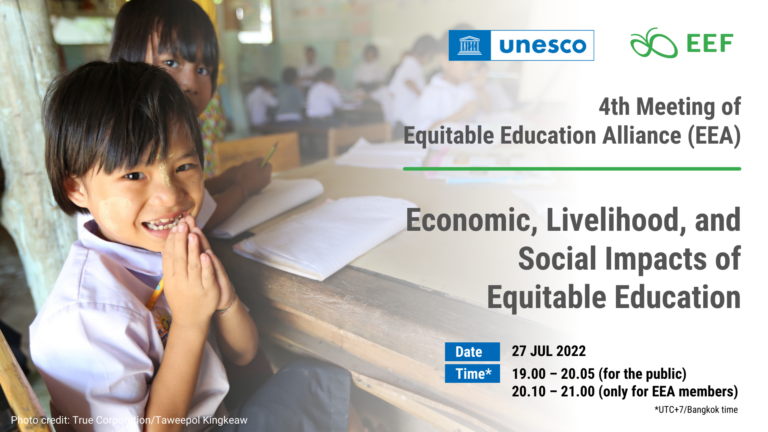
Equity in education is the core concept and principle directed to the goal of all individuals achieving their educational potential. It also means that aspects of individual identity, such as gender, ethnic origin, economic standing, or family background, should never be obstacles to acquiring at least a basic level of education and skills. Understanding the importance of promoting and translating equity in all forms and levels of education, the global community reaffirmed its support for equity at the 2015 World Education Forum by adopting the Incheon Declaration, which provides guidance for implementing the SDG4: Education 2030 Agenda.
Although the adoption of SDG4 demonstrates a global commitment to equity and inclusion in education, current data shows that more needs to be done, especially at the country level. Efforts at reducing the number of out-of-school children around the world has slowed over the past decade. A massive number of children and youth — about 258 million — were reportedly out of school for the school year ending in 2018, according to the UNESCO Institute for Statistics (UIS). This number represents 59 million children of primary school age, 62 million of lower secondary school age, and 138 million of upper secondary age. Thus, to tackle such an ongoing challenge, SDG17 was implemented to strengthen the alliance of partnerships for equitable education goals.
Since the beginning of 2020, the Equitable Education Fund (EEF) of Thailand, with the technical support provided by the UNESCO Asia and Pacific Regional Bureau for Education (UNESCO Bangkok), has been exploring the possibility of establishing the Equitable Education Alliance (EEA) as an international network to effectively promote equitable education and form a community of practitioners. Three meetings were held in February, June, and November 2020 to explore this concept. The goal was to network with countries and international organizations that are strong advocates for equity in their education systems, learn about their work, and assess the possibility of forming the desired Alliance. A total of 11 countries¹ and six international organizations² participated in these meetings and shared how they promote and foster equity in their education systems through:
legal frameworks and policy development;
budgeting and financing mechanisms;
service delivery; and
monitoring and evaluation.
As the innovations project Regional Promotion of Equitable Education is transitioning into phase II, EEF and UNESCO Bangkok are holding the 4th Equitable Education Alliance meeting on Economic, Livelihood and Social Impacts of Equitable Education to restart the alliance development and further grow the network.
¹ Australia, Canada, China, Finland, Japan, Malaysia, New Zealand, Republic of Korea, Thailand, the United Kingdom, and the United States.
² Educate A Child, Global Partnership for Education (GPE), Organisation for Economic Co-operation and Development (OECD), UNESCO Bangkok, UNICEF East Asia and Pacific Regional Office, and UNICEF Thailand.
Objectives
- Showcase the economic, livelihood and social benefits of equitable education for society overall.
- Bring together organizations working towards equity in education and to explore collaboration
opportunities to be used as a basis for further development of EEA. - Present recent major developments in the EEF’s work, including the Regional Conference on Teachers
and Equitable Education: All for Education in Southeast Asia of October 2021.
Expected Participants
- Participants who have attended previous meetings.
- Potential members, including government agencies, policymakers, NGOs, academics and 20
like-minded organizations and countries that have not participated in previous meetings. - EEA members, including practitioners, technical experts, and organizations which work in practice for
equitable education.
Contact
For more information, please contact: UNESCO Bangkok Education Section – [email protected]