To provide the best experiences, we use technologies like cookies to store and/or access device information. Consenting to these technologies will allow us to process data such as browsing behavior or unique IDs on this site. Not consenting or withdrawing consent, may adversely affect certain features and functions. https://equity-ed.net/cookies-policy/
The technical storage or access is strictly necessary for the legitimate purpose of enabling the use of a specific service explicitly requested by the subscriber or user, or for the sole purpose of carrying out the transmission of a communication over an electronic communications network.
The technical storage or access is necessary for the legitimate purpose of storing preferences that are not requested by the subscriber or user.
The technical storage or access that is used exclusively for statistical purposes.
The technical storage or access that is used exclusively for anonymous statistical purposes. Without a subpoena, voluntary compliance on the part of your Internet Service Provider, or additional records from a third party, information stored or retrieved for this purpose alone cannot usually be used to identify you.
The technical storage or access is required to create user profiles to send advertising, or to track the user on a website or across several websites for similar marketing purposes.




 English
 Arabic
 Chinese (Simplified)
 Filipino
 French
 Hindi
Hindi Indonesian
 Italian
 Javanese
 Khmer
Khmer Lao
Lao Malay
Malay Myanmar (Burmese)
 Nepali
 Portuguese
 Russian
 Spanish
 Thai
Thai Vietnamese
The COVID-19 pandemic has demonstrated more than ever that global crises require global solutions. In April, faced with a global health emergency like no other, the international community came together in what UK Prime Minister Boris Johnson hailed as a “new era of global health collaboration”. The World Health Organisation (WHO) led a virtual meeting where world leaders agreed to work together on a coronavirus vaccine and share research, treatments and medicines across the globe. This was followed in May with an EU-hosted virtual summit where leaders pledged nearly €7.4 billion to research COVID-19 vaccines and therapies, pledging that the money will be used to distribute any vaccine to poor countries on time and equitably.
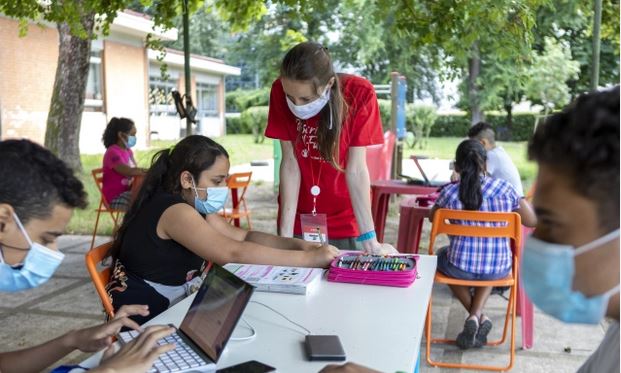
But the COVID-19 pandemic is not just a global health emergency. Efforts to mitigate the spread of the virus – such as school closures – are having a devastating impact on the lives of children everywhere, but especially in the poorest countries. School closures put girls at risk of child marriage, which has reportedly doubled in parts of Malawi according to Care International where, even before the pandemic, around half of all girls got married before the age of 18……………………………………………………..